Sometimes I worry if I should have chosen dev over design. The allure is real - my analytical bent of mind often lures me in, but I also love to notice deep patterns in human behaviour, actions, history and politics — all things that eventually govern the decisions that run the world.
The golden goose fumble
The Golden goose story is a part of common human psyche. It serves to inform the mind that the path of greed — the path of wanting everything — sooner or later causes one to lose it all.
Now, commonly due to it's material analogue, a golden egg would mean a million dollar idea, business, or a title but at a macro scale, it seems like humanity has fumbled on this egg and ignored it's own reflection in it.
The declining birth rates around the world — specially in first world countries are an indicator that the golden goose is dying. The worse problem is that there's no easy/ quick or AI powered solution to this.
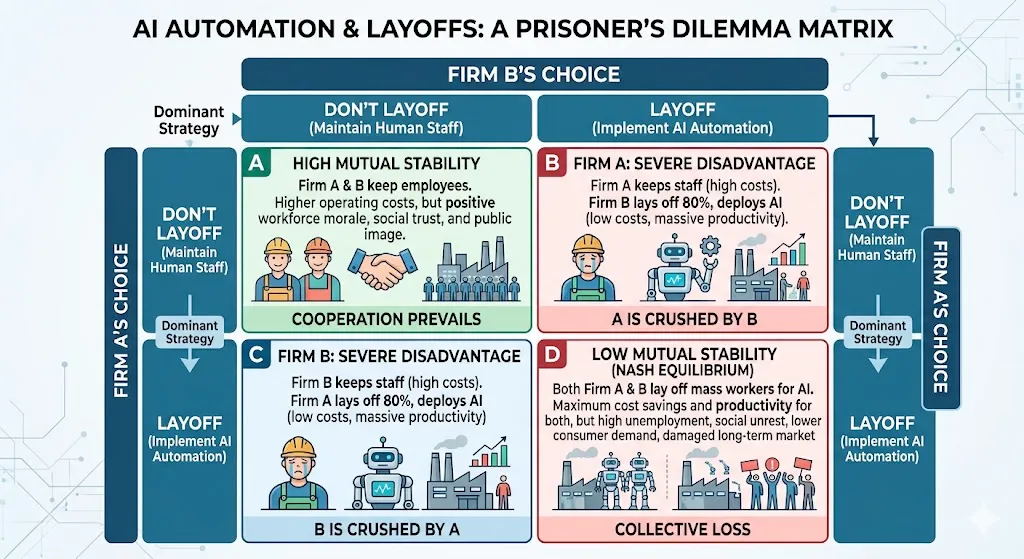
Quite the opposite, AI or those who wield the narrative have aggravated this [1]problem.
The narrative disconnect
Whenever someone is fed the narrative that you're replaceable, it propagates a culture of dehumanisation. Dehumanisation of value and of labour. A person's life's struggles and wins are invalidated in exchange of a mere metric. And when pushed too far, people either revolt or worse,retreat into nihilism.
Jim Prosser in his blog AI, "Humanity", and Dr. Manhattan Syndrome uses the character of Dr. Manhattan from the graphic novel Watchmen as a metaphor. Dr. Manhattan is a godlike being who can perceive quantum physics and the entire arc of time. While he cares about humanity's survival in a detached cosmic sense, he completely loses the ability to empathize with or care about individual humans. Prosser asserts that executives have adopted this exact mindset—they love the theoretical concept of Humanity because it is easy to model and optimize, but they find real people (who sue, protest, and worry about their livelihoods) to be a nuisance.
The way ahead
The outcome – hence is before us. but the thing about humans is we are resilient and we have a strong thing working for us. Our hope. The power to create virtue in the face of adversity and inherent meaninglessness.
But it's nothing new; history demonstrates a recurring, spiral pattern where periods of intense socioeconomic hardship ultimately generate the collective energy required to fuel major cultural and progressive eras. This societal shift is visible in the transition from the corporate monopolies of the Gilded Age into the worker protections of the Progressive Era, as well as the traumatized "Lost Generation" of the 1910s catalyzing the artistic explosion of the Roaring Twenties.
Today, the severe psychological and economic pressures facing Gen Z—driven by algorithmic isolation, wealth inequality, and rapid technological disruption—closely mirror these historical inflection points. While currently characterized by high rates of anxiety and nihilism, populations historically reach a critical threshold where prolonged systemic distress triggers active resistance rather than numbness.
The emerging popularity of community-focused volunteering, indie media, and optimistic "hopecore" aesthetics indicates a structural shift away from digital complacency toward a new era of human-centric art, social reform, and cultural rebuilding. Whether we are able to save the golden goose, is
Appendix
Tragedy of commons
A database responses to multiple micro service queries works only when microservices treat the database as a shared resource and limit the number of queries preventing the collapse of the db entirely. A tragedy of the commons. This problem doesn't save itself.
Dominant Strategy
A dominant strategy – is the trap that most companies fall into causing a prisoner's dilemma.